For years, crushing equipment was judged mainly by one question: how many tonnes can it process per hour? That question still matters, but it is no longer sufficient. In 2026, mine operators, coal-handling plants, quarries, and bulk-material terminals are increasingly expected to deliver throughput with lower energy intensity, less dust, lower noise, safer maintenance, and better control of operating risk.
That shift has changed the role of the high-capacity mineral sizer. Properly selected, a low-speed twin-shaft mineral sizer can reduce ROM material in a compact footprint while supporting a more measured approach to power consumption and particle generation. It is not a universal replacement for every crusher. It is a purpose-built solution whose sustainability value appears when the material, feed arrangement, sizing duty, and downstream process are right.
This article explains what eco-friendly crushing means in practical terms, how modern high-capacity mineral sizers contribute, and what buyers should ask before treating a “green” claim as a performance advantage.
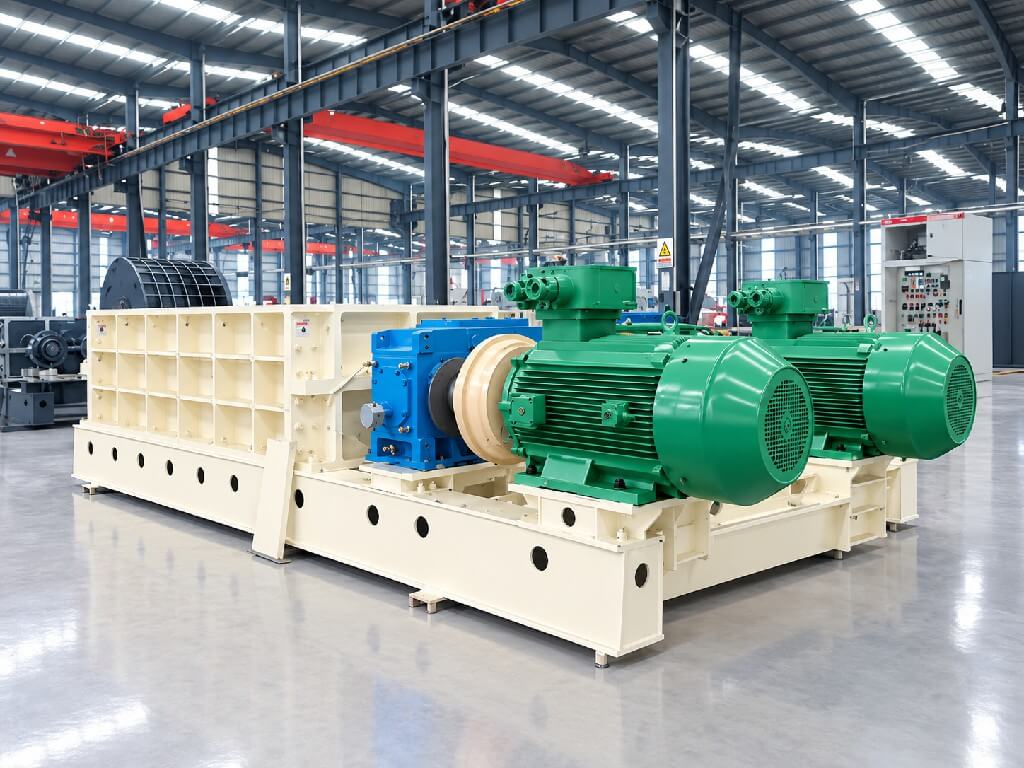
Eco-Friendly Crushing Is an Operating Strategy, Not a Paint Colour
Sustainable crushing equipment is sometimes marketed through broad labels: low-carbon, energy-saving, dust-free, intelligent, or green. These terms can be useful starting points, but they are not specifications. The environmental performance of a crushing circuit depends on the complete operating system: material preparation, feed control, machine selection, installed power, product requirements, enclosure design, maintenance practice, transport, and plant uptime.
For a plant team, eco-friendly crushing normally means making measurable improvements in areas such as:
- Energy per tonne: Producing the required size reduction without unnecessary power draw or repeated crushing.
- Dust and fugitive material: Limiting dust at transfer points, reducing uncontrolled spillage, and supporting effective extraction or suppression where required.
- Noise and vibration: Reducing avoidable emissions that affect personnel, neighbouring operations, and surrounding communities.
- Resource use: Extending wear-part life, reducing waste from premature component changes, and designing for repairable, serviceable equipment.
- Process efficiency: Maintaining stable feed and product size so downstream conveyors, screens, mills, or washing systems do not consume energy correcting an upstream problem.
- Worker safety: Providing guarded drives, safe access, lifting points, isolation provisions, and maintenance procedures that reduce exposure during servicing.
The important word is measurable. A responsible supplier should be willing to discuss duty assumptions, expected operating range, installed versus absorbed power, wear-part strategy, and the boundaries of any performance claim. Sustainability is strongest when it is designed into the duty, then verified using plant data.
Why High-Capacity Mineral Sizers Fit the Modern Crushing Conversation
A twin-shaft mineral sizer uses slowly rotating toothed shafts to grip, compress, shear, and size incoming material. The action is fundamentally different from a high-speed impact machine. Rather than repeatedly throwing material against impact surfaces, the sizer applies controlled breakage at the teeth and through the gap between the shafts or breaker elements.
This operating principle can offer valuable benefits in suitable applications:
- Low rotational speed can reduce airborne dust and noise relative to processes with more violent particle acceleration, although final site performance also depends on feed and enclosure design.
- Controlled tooth geometry and shaft spacing can reduce material directly to a target range, helping to avoid unnecessary over-crushing and excess fines.
- A high-capacity mineral sizer can accept large ROM feed in a compact layout, potentially simplifying material transfer points and civil work.
- High starting torque and controlled drive systems can support difficult materials such as wet coal, lignite, clay-bearing feed, soft-to-medium rock, salt, gypsum, and selected ores.
- Modular tooth segments and wear components can support planned maintenance instead of replacing a larger assembly before its useful life is exhausted.
These advantages are conditional, not automatic. Extremely hard, highly abrasive, or strongly variable feed may favour another crushing technology or require a carefully engineered sizer configuration. The right question is not, “Is a mineral sizer greener than every other crusher?” It is, “Can this mineral sizer meet our product and capacity duty with lower total resource use than the realistic alternatives?”
Energy Efficiency Starts with the Right Reduction Duty
Energy efficiency is often reduced to the motor nameplate. In reality, a motor’s installed kilowatts are only one part of the picture. The useful measure is energy consumed per tonne of material processed at the required product specification, under normal operating conditions.
An energy-efficient mineral sizer begins with matching the machine to the task. Asking a crusher to make a product finer than the downstream process requires consumes energy to create fines that may add no value. Poor feed control makes the drive respond continually to surges, voids, and oversize events. An oversized sizer in a low-duty application can carry unnecessary capital and installed-power cost. At the other extreme, an undersized unit may operate near its limits, increase wear, and force a secondary stage to correct the result.
When reviewing a high-capacity mineral sizer, request the supplier’s design basis for:
| Design input | Why it matters to energy performance |
|---|---|
| Material type, density, moisture, strength, and abrasive content | These factors affect breakage force, tooth selection, and actual power draw. |
| Maximum lump size and feed size distribution | Determines engagement load and whether the machine can process oversize without unstable operation. |
| Normal, peak, and surge capacity | Helps size the shafts, drive, and feeder control for real throughput rather than a catalogue maximum. |
| Target product size and permissible fines | Prevents over-specifying size reduction that wastes energy or harms downstream recovery. |
| Feed arrangement and material head load | Influences torque demand, throughput consistency, and potential for uncontrolled compression. |
| Annual operating hours and operating profile | Provides a meaningful basis for annual energy and lifecycle-cost comparison. |
Ask bidders to distinguish installed motor power, anticipated operating power, and the conditions behind their estimates. These are not interchangeable figures. A credible comparison also considers auxiliary loads: feeder drives, dust extraction, pumps, conveyors, and any secondary crushing that the proposed product size may require.
Less Fines Can Mean Less Work Across the Plant
Excess fines are not merely a product-quality issue. They can raise dust levels, create handling losses, increase screen loading, affect wash-plant behaviour, and change how material moves through chutes, bins, and conveyors. In some mineral and coal applications, they can also reduce the value of the saleable product.
The controlled breakage action of a mineral sizer can help an operator target the product size needed for the next stage. Tooth profile, shaft speed, tooth spacing, breaker-bar arrangement, and feed condition all influence the outcome. A well-designed configuration aims to break material once, as far as practical, rather than relying on repeated impact to achieve size reduction.
However, it is important not to promise “zero fines.” Fine generation is influenced by the feed’s natural fracture behaviour, moisture, degradation before crushing, and the required top size. The appropriate target is a defined, application-specific product distribution with as little unnecessary degradation as practical. That is a meaningful standard for operational sustainability because every avoidable fine is material and energy that the rest of the plant must manage.
Dust, Noise, and Enclosure: Design the Whole Interface
Low-speed crushing is a useful foundation for environmental control, but the crusher alone does not determine the site’s dust or noise outcome. The feeder discharge, hopper, transfer chute, product conveyor, and building enclosure are often equally important.
For a high-capacity mineral sizer installation, review the complete material path:
- Feed control: A consistent apron feeder, chain feeder, or other suitable feeder can prevent uncontrolled surges and material drop that create dust and impact noise.
- Chute design: Correctly shaped, lined chutes reduce free fall, leakage, hang-up, and the need for manual intervention.
- Enclosure and extraction: Local enclosure and a properly designed extraction or suppression system should be selected for the material and local environmental requirements.
- Conveyor transfer: Well-sealed loading zones and stable belt tracking prevent secondary dust and spillage after the crusher.
- Inspection access: Doors, viewing points, and safe access allow teams to find build-up or wear before it develops into a dust or reliability problem.
Where noise is a sensitive issue, compare machine sound data using a consistent test and installation basis. The final sound level at a work area or site boundary depends on enclosures, structure-borne transmission, surrounding surfaces, and adjacent equipment. Responsible procurement avoids comparing isolated numbers that were measured under different conditions.
High Capacity Without High Waste: The Maintenance Equation
A mineral sizer’s environmental value is closely tied to its serviceability. A machine that survives a decade but requires a large quantity of difficult-to-replace wear material every few weeks is not automatically a sustainable choice. Conversely, a well-designed wear package can keep a high-capacity mineral sizer productive while using labour and materials more efficiently.
Look for practical features such as:
- Replaceable tooth segments or shells that protect the underlying shaft or carrier.
- Wear liners, breaker bars, and side protection designed around known wear zones.
- Clearly identified fasteners, retention systems, and installation orientation to reduce errors during a shutdown.
- Safe access for inspection, lifting, lockout, and replacement work.
- Drive components from supportable suppliers, with documented model numbers and maintenance data.
- Condition monitoring for critical variables such as torque, speed, temperature, lubrication condition, vibration, or drive alarms where appropriate to the design.
Wear parts should be selected for the actual failure mode. A tooth that is exceptionally hard can be valuable in pure abrasion, but it may not be the best answer where high impact risks chipping or fracture. A high-quality mineral sizer manufacturer will discuss feed characteristics, wear history, geometry, material selection, and replacement interval as one package. It should also explain what evidence it uses to support a recommended alloy or hardfacing solution.
The goal is not to minimise wear-part price. It is to minimise the cost and environmental burden of productive tonnes over the part’s service life, including manufacturing, freight, changeout labour, downtime, and disposal or recovery routes.
Smart Drives and Data: Turning Efficient Design into Efficient Operation
Modern drive and control systems are making sizers easier to operate within their intended envelope. Variable-frequency drives, torque monitoring, interlocks, automatic reversal logic, and condition alarms can help operators manage feed fluctuations and prevent a developing blockage from becoming a major interruption.
The value lies in the response strategy, not in automation for its own sake. For example, torque data can highlight a sustained change in feed resistance, an incorrectly set gap, a damaged tooth, or unexpected material. A well-configured control system can alert the operator, regulate the upstream feeder, or initiate a controlled protective sequence based on the application’s risk assessment.
Data can also strengthen sustainability decisions. Record at least throughput, operating hours, power consumption where available, torque events, product-size checks, downtime causes, and wear-part life. Over time, this reveals whether a machine is consuming more energy than expected because of feed variability, worn geometry, poor loading, or a downstream restriction. It turns “we think the crusher is working harder” into a question that can be investigated with evidence.
As with any connected equipment, control changes and remote-access arrangements should align with the plant’s cybersecurity, functional-safety, and change-management requirements. Digital features are valuable only when the operating team can trust and maintain them.
Modern Standards: What Buyers Should Expect in 2026
International projects face different legal requirements, permitting conditions, and client specifications. There is no single global rulebook that makes one crusher environmentally compliant everywhere. Yet buyers can set a strong, consistent procurement standard by requiring evidence across five areas.
| Review area | What to request from the mineral sizer supplier |
|---|---|
| Safety and machine guarding | A clear description of guarding, emergency-stop provisions, isolation points, access design, manuals, and the applicable project requirements. |
| Environmental interfaces | Installation data needed to design dust, noise, drainage, containment, and waste-handling measures around the equipment. |
| Energy and performance | Duty calculations, motor and drive details, anticipated operating range, and assumptions for any capacity or efficiency estimate. |
| Material and quality control | Wear-part material specifications, inspection plans, traceability appropriate to the order, and document revision control. |
| Lifecycle support | Recommended spares, maintenance intervals, drawings, training scope, service access requirements, and realistic lead times. |
Ask the supplier to state the standards and project specifications it is designing to, then have the owner or EPC verify their applicability at the installation location. This distinction matters. A manufacturer can supply useful documentation and engineering input, but the project owner must ensure the completed plant meets local permits, safety rules, emissions limits, electrical requirements, and operating obligations.
Avoiding Greenwashing in Sustainable Crushing Equipment Procurement
Sustainability claims deserve the same disciplined review as capacity claims. Before accepting a statement that a crusher is low-energy, low-noise, or environmentally superior, ask for the operating context.
Useful questions include:
- Compared with which technology, feed material, product size, and throughput?
- Is the figure measured, calculated, or based on a previous project? What were the assumptions?
- Does the claim include auxiliary equipment and the downstream effects of product size?
- How do expected tooth life, liner consumption, and maintenance intervals compare under similar duty?
- What site measures are still required to control dust, noise, runoff, spillage, and waste?
- Can the supplier provide operating references or field evidence relevant to the application?
Avoid making a purchasing decision from a single kWh-per-tonne figure without checking its boundaries. The most useful comparison may be the total energy and material use required to deliver one tonne of correctly sized product through the next process stage. This is where a correctly applied high-capacity mineral sizer can show its value.
A Practical 2026 Sourcing Checklist for High-Capacity Mineral Sizers
Before issuing an RFQ or approving a proposal, work through the following checklist:
- Define material characteristics, feed distribution, moisture, abrasiveness, maximum lump size, capacity range, and target product size.
- Map the whole circuit, including upstream feed control, downstream conveying or screening, dust collection, and anticipated maintenance access.
- Compare expected energy per productive tonne, not motor size alone.
- Ask how the design limits unnecessary fines, and how that claim relates to the specific feed.
- Review tooth, breaker-bar, liner, and fastener design together with their expected replacement method.
- Require drawings, equipment data sheets, design assumptions, inspection requirements, and clear revision control.
- Assess guarding, safe isolation, lifting, access, controls, and manuals as part of the environmental and safety case.
- Obtain a realistic spare-parts plan that accounts for lead time, transport distance, operating hours, and the cost of a shutdown.
- Require transparent wording around dust, noise, energy, and capacity claims; do not accept unsupported superlatives.
- Plan how throughput, power, wear, downtime, and product size will be measured after commissioning.
This process does more than reduce environmental risk. It improves the likelihood that the selected machine will deliver predictable production, a serviceable maintenance plan, and defensible lifecycle value.
The Future Is Application-Specific, Data-Led, and Built to Last
Eco-friendly crushing in 2026 is not a choice between productivity and responsibility. The stronger projects pursue both. They choose the reduction method that matches the feed, prevent waste before it starts, design dust and noise control around the entire material path, use energy data rather than assumptions, and specify wear packages that can be maintained safely and sensibly.
For the right ROM coal, soft-to-medium mineral, salt, gypsum, clay, and bulk-material duties, high-capacity mineral sizers offer a compelling route to controlled sizing in a compact and serviceable package. Their contribution to sustainability is earned through correct engineering and disciplined operation—not claimed through a label.
That is the standard buyers should carry into every crushing project: fewer unsupported promises, more application data, and equipment that creates the required product with the least practical burden on energy, people, and resources.
FAQ
High-capacity mineral sizers can be energy efficient when their controlled, low-speed crushing action matches the material, feed size, and required product size. The fair comparison is energy per tonne of correctly sized product across the relevant process, including downstream screening or secondary crushing—not installed motor power alone.
High-capacity mineral sizers can reduce violent particle acceleration and unnecessary fines in suitable duties, which may help the overall dust-control strategy. Effective results still require controlled feed, well-designed chutes, enclosure, extraction or suppression where needed, and sealed conveyor transfer points.
An energy-efficient mineral sizer is commonly considered for ROM coal, lignite, salt, gypsum, clay-bearing material, soft-to-medium rock, and selected ores. Suitability depends on the feed’s strength, abrasiveness, moisture, lump size, tramp-metal exposure, required product size, and capacity. Very hard or highly abrasive material requires a specific technical assessment.
A sustainable mineral sizer should provide replaceable wear components, clear part identification, protected high-wear zones, safe inspection and lifting access, documented drive and lubrication arrangements, and a practical condition-monitoring strategy. These features help extend component life, reduce changeout errors, and improve planned-maintenance efficiency.
Ask a mineral sizer manufacturer for the exact duty assumptions behind capacity, energy, dust, noise, and wear-life claims; the expected operating range; equipment data sheets; safety and access details; and the installation interfaces needed for enclosure, extraction, drainage, and controls. Request comparable operating evidence where it is available, and verify final project compliance against local requirements.